Sunday, December 5, 2010

Waiting For The Day Of The Lord


The second candle of advent was lit today in recognition of the prophets.
The prophets heralded the coming of Christ, the day of the Lord.
This week we're focusing on waiting for the day of the Lord.

"The second candle on the Advent wreath is associated with the prophets and, in particular, their prophecies of the "one who is to come." With this candle, therefore, we are waiting for the future and all that it might hold."

The day of the Lord...it can bring different pictures to mind. Isaiah for instance was talking about the day of the Lord meaning deliverance for Judah from the Assyrians. But he was also referring to the day of the Lord meaning Jesus being sent for our redemption. Today, when one references the day of the Lord, we automatically think of the end of times, and the second coming. Either way, all three are instances of God's people waiting for the day of the Lord. The day of our redemption and deliverance.

This second candle brings more light to darkness, more hope to our waiting. The hope is growing stronger with the light that our waiting will not be in vain. We are waiting for someone to fulfill the prophecies of a peaceful world in which a lion will lie down with a lamb, where a virgin will have a son and call Him Immanuel, a son who will establish a kingdom and uphold justice with righteousness forevermore.

Of course everyone has their own private idea of a savior. Maybe someone on a white horse with shining armor, ready to combat the dragons at the gate. Maybe a warrior with arrows at the ready to conquer the enemies pouring down upon them. Someone who changes the darkness of fear and oppression to the light of gladness, peace, and happiness. The Israelites were expecting a savior who would free them from the oppression of their enemies, who would bring peace to their land once again. Their idea of a savior looked more like the fierce warrior on the white horse.
"As is so often the case, Jesus fulfills these ancient prophecies in a surprising way, and it is through weaving light into the shade of our present world that he evokes wonder by the wisdom of his counsel; shows the power of God in the world's cares eternally just like a parent; and is the source of all well-being for God's people. Jesus lived as wonderful counsellor, mighty God, everlasting father, and prince of peace in the midst of our broken, despairing world, shining in the darkness and bringing hope. 
It is this light shining in the darkness for which we wait, and the season of Advent calls us to readjust our eyes in that darkness so that we can see glimmers of the Light of the World, glowing and pointing us forward to that ultimate time in the future when everything will be fulfilled...."

And so we wait. Quietly, in the darkness, staring at the shine and glow of two candles. One reminding us silently of how we are called to wait. The second, that we are waiting for the day of the Lord.

Waiting is not just sitting around, slightly bored, passively waiting for the next thing.

" The Hebrew word that is often translated wait (as in Genesis 49:18, "I wait for your salvation, O Lord") has the additional meaning of "look eagerly" or "lie in wait for" that brings with it that concept of being a "lookout" whose sole task is to gaze into the distance, waiting for a particular person to come, and then, when they do come, to be able to distinguish them from the others who come the same way....Waiting for the future involves a recognition of what the world might be and the resolve to bring our own part of it one step closer....Waiting becomes active: waiting for the future involves transforming the present."
Active waiting, then is the proper outlook for Advent. We're actively waiting for the day of the Lord when we reach out to others and bring the light closer to shining throughout the world.

So on this second Sunday in Advent, think of the prophets who were actively waiting for the Savior of the World...for the light to chase away the darkness. And actively wait for the day of the Lord.


All exerpts taken from the book by Paula Gooder, The Meaning Is In The Waiting

Wednesday, December 1, 2010

Psalm 37:23-24


 The LORD makes firm the steps 
   of the one who delights in him; 
 though he may stumble, he will not fall, 
   for the LORD upholds him with his hand.

Psalm 37: 23-24

Sunday, November 28, 2010

The Meaning Is In The Waiting


Waiting is increasingly a strange notion. After all, we have microwaves for fast instant food. We have cell phones for instant access. We have digital books for instant download. We have google for instant answers. We are increasingly impatient when something is not forthcoming as quickly as we think it should be.

Then we have Christmas.
It starts in August and is celebrated sometimes until January.
What happened to looking forward to Christmas?
What happened to saving the dessert for after dinner?

Why is Christmas in full swing as soon as the Halloween candy is on sale?

Advent is a time of waiting.
Advent is a time of anticipating.
Advent is a time of looking forward to the coming of Christ.
To quote the book, The Meaning Is In The Waiting,
 "Advent lies in waiting. Waiting rests not in frustration but in stillness. Not frenzied anticipation but in embracing the present. We need to relearn how to wait, to rediscover the act of savoring the future of staying in the present and of finding meaning in the act of waiting."

The first Advent candle was lit today. The first candle represents Abraham and Sarah, our ancestors in the faith, the patriarch of our Savior. And it represents expectation. The expectation that God will follow through with His promises. The expectation that our waiting is not in vain.

Abram was called to wait. He packed up his household, turned down his birthright, (unheard of!) and was sent on a journey to a new land...but he had to wait to find out where it was.
He was promised a great nation, but had no children until his old age. He was called to wait for the child who would fulfill that promise. Even then, he did not live to see the nation that came from his waiting.

Abram's call was to wait, but it was also to change. We know he had had big change in his life already: His father had moved the family once, establishing himself in a new town with new acquaintances and associates. But here he was, asked to make changes again. Leave his father's house, his relatives, his inheritance, to go to an uncertain place.

One thing I learned while in Israel was that Hebrews have a way of thinking that is completely different. They're always changing. They're always doing things differently. The lady I was traveling with has been in Israel many many years. She was even recently there just a couple months before I visited. Yet she remarked constantly on how things had changed even from when she was there a couple months before. Israelis have no problem changing the way they do things.

It strikes me that maybe they get this from their patriarch.

Quote: "The voice that spoke to Abram still speaks to us: "Go, from the things that bind you, from the sense of your own identity, from your day-to-day way of being to something that I shall show you." God calls, and waits for our response....
God's call to us remains a call to change; to leaving and accompanying, to moving and changing, to growing and flourishing. It is part of human nature to yearn for stability, to put down roots, and to stay put; but it is also a rule of nature that things that do not move do not live. Water that does not move becomes stagnant, and in the same way when we do not move we become sluggish and hard to change. God's call does not necessarily ask us to move our physical surroundings, (although sometimes it does); most often it asks us to move our internal surroundings, to be prepared to be changed and transformed." 

We are asked to wait. We are asked to change. We change in the waiting. Waiting is an essential part of our journey with God.

Abraham was asked to change, was asked to wait. He moved forward, not knowing exactly where his journey was leading. He and Sarah were promised a family, a land, a nation. They thought they had waited in vain for the family to materialize. They became anxious and tried to fix up for themselves how it would all work out. But Ishmael was not the child God was planning to use to form this nation.
In the end, after all the pain of waiting, all the anxiety of the unknown, of not knowing exactly where they were headed  or how it would work out, they finally had their promise fulfilled. Isaac was born. He grew, and then God did an unexpected thing: He asked Abraham to sacrifice his son. Abraham prepares to do so, but what questions must have run through his mind. How could he now have another son to fill the spot of Isaac? How about the nation that would outnumber the stars? Yet in faith Abraham acted, and God provided a sacrifice instead of Isaac.

Abraham and Sarah became symbols for us not only of faith but also of waiting: of waiting as an essential part of our journey with God, of waiting being vital for the proper unfolding of God's plan, and of waiting being as important as that for which we wait. God summons us to go out but does not always tell us where to, or why...for that we must wait, but in the waiting we can, sometimes, discover a meaning.

The first candle is for Expectation. The first candle is for the Patriarchs of our faith. Who often had to wait.

Saturday, November 27, 2010

A Journey of Waiting: The Meaning Is In The Waiting

Kneeling

Moments of great calm,
Kneeling before an altar
Of wood in a stone church
In summer, waiting for God
To speak; the air a staircase
For silence; the sun's light
Ringing me, as though I acted
A great role. And the audiences
Still; all that close throng
Of spirits waiting, as I,
For the message.
Prompt me, God;
But not yet. When I speak,
Though it be you who speak
Through me, something is lost.
The meaning is in the waiting.

R. S. Thomas


A Journey of Waiting.
Join me every week in Advent as I read and study the book, The Meaning Is In The Waiting by Paula Gooder. 
A journey of waiting, a journey looking for the coming of Jesus.


Wednesday, November 24, 2010

A Picture of Love


This is one of my favorite pictures from my trip to Israel. The background is the Sea of Galilee. The stomping grounds of Jesus.
I took this photo at Capernum. There is a Greek Orthodox church there and there is a gate with this decorative iron cross looking out toward the sea.


This Thanksgiving I am thankful for what this picture represents. It reminds me of Jesus. His home town was Capernum. He lived and preached all around the sea. Then He died for my sin on a cross. His essence. His life. His death. His love.

All in one picture.

A picture is worth a thousand words they say.

A picture of His Love.

Sunday, November 21, 2010

Sun and Moon

Psalm 148


 1 Praise the LORD.

   Praise the LORD from the heavens; 

   praise him in the heights above. 

2 Praise him, all his angels; 
   praise him, all his heavenly hosts. 
3 Praise him, sun and moon; 
   praise him, all you shining stars. 
4 Praise him, you highest heavens 
   and you waters above the skies.


 5 Let them praise the name of the LORD, 

   for at his command they were created, 

6 and he established them for ever and ever— 
   he issued a decree that will never pass away.


 This Sunset was taken at En Gev Kibbutz looking at the opposite side of the Kinneret towards Tiberias. 


This moon was taken in Migdal. 

Sunday, November 14, 2010

The Eye Of A Needle...

18 A certain ruler asked him, “Good teacher, what must I do to inherit eternal life?”
   19 “Why do you call me good?” Jesus answered. “No one is good—except God alone. 20 You know the commandments: ‘You shall not commit adultery, you shall not murder, you shall not steal, you shall not give false testimony, honor your father and mother.’[a]”
 21 “All these I have kept since I was a boy,” he said.
 22 When Jesus heard this, he said to him, “You still lack one thing. Sell everything you have and give to the poor, and you will have treasure in heaven. Then come, follow me.”
 23 When he heard this, he became very sad, because he was very wealthy. 24 Jesus looked at him and said, “How hard it is for the rich to enter the kingdom of God! 25 Indeed, it is easier for a camel to go through the eye of a needle than for someone who is rich to enter the kingdom of God.” Luke 18:18-25

One day as I was walking in Jerusalem I came across a little door. Then suddenly this story came to mind as I realized that I was looking at the eye of a needle. City gates and other entrances had these eyes as a way to let people through after the big gate or door is closed for the night and before it was opened in the morning.


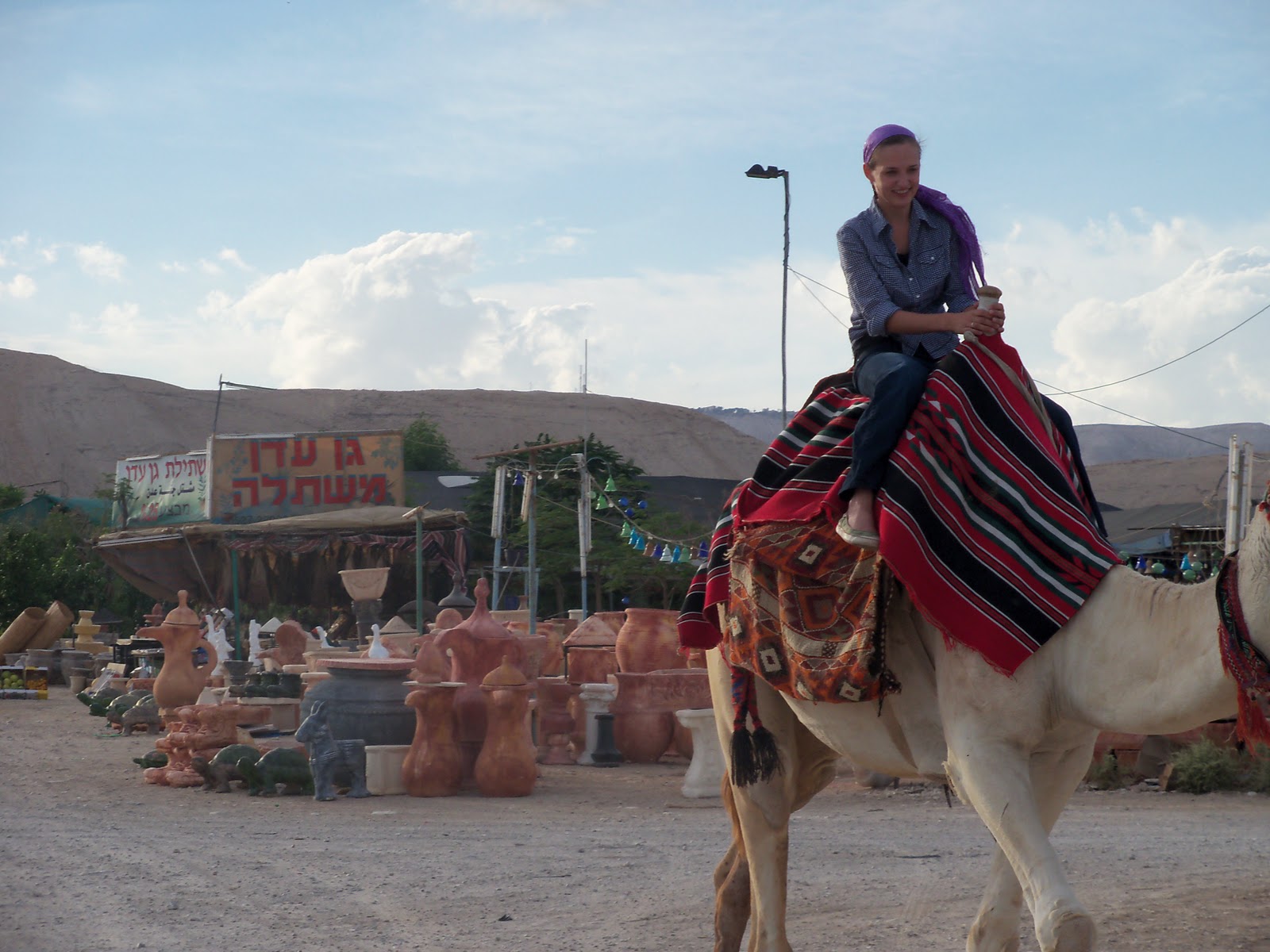
Later in the day I happened to have the chance to ride a camel. Now the story really came to life. I recalled how small the door was as I stood next to the sitting camel.


Then I imagined the group around Jesus as he was talking to the ruler. He was traveling to Jerusalem. All the disciples were with him, as well as a large group of followers.  Jesus was telling parables and teaching. I always like to imagine the sights and sounds and smells around. Jesus had a habit of using what was at hand to illustrate his teaching. I imagine them near sundown sitting near the gate. This is the place men gathered to talk and meet. Women are coming to the well to get water. The crowd lingers to catch every word this man has to say. The Pharisees are arguing and debating. Children running and playing. Cooking smells are in the air. Just then a string of camels loaded with goods on the oriental trade route nears.  The ruler approaches and asks Jesus his question. As they talk, they're idly watching the camels near the gate. Suddenly Jesus uses them to illustrate his point! How much easier for the camel to go through the eye of the needle than the rich man to sell all he has to follow Jesus! The crowd would have immediately looked at the size of the loaded camels against the familiar eye of the needle of their own city gate. The contrast was so impossible, it cemented the idea of how hard it is to enter the kingdom into their minds.

I know when I saw the door, and then the camel it cemented the story in my mind. And oh how I don't want to be like the rich ruler who couldn't let go of his riches to follow Jesus!